British Special Forces in the Second World War
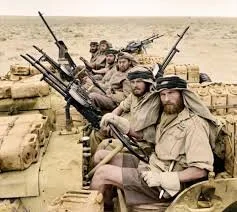
A colourised image of SAS `Troops in Second World War
In this blog post I’m going to discuss three of the principle special forces of the British forces during the Second World War. These will be the Special Air Service, Special Boat Section (later becoming the Special Boat Service) and Long Range Penetration Groups (also known as The Chindits).
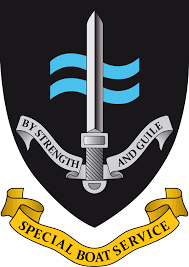
A picture of the SBS cap badge
Special Boat Section
The founder of the SBS, Roger Courtney MC became a Commando in the middle of 1940 and was sent to the Combined Training Centre in Scotland. He had an idea that a brigade of raiders arriving on folding kayaks would be effective. He attempted to persuade Admiral of the Fleet, Sir Roger Keyes and later Admiral Theodore Hallett but was unsuccessful in his attempts. He decided he would infiltrate HMS Glengyle which was anchored in the River Clyde to prove how successful his idea could be. He paddled to the ship, climbed aboard, wrote his initials on the door of the Captains cabin and stole a deck gun cover. After presenting the cover to a group of high ranking Naval officers meeting at a nearby hotel, he was promoted to Captain and given command of twelve men to form the first Special Boat Section.
Based on Isle of Arran, they were initially called Folboat Troop, after the type of canoe they used. Attached to Layforce (an ad-hoc group of Commando units based in the Mediterranean Theatre) they moved to the Middle East, working with the 1st Submarine Flotilla based at Alexandria. The SBS performed beach reconnaissance of Rhodes, helped evacuate troops left behind on Crete and carried out a number of small scale raids and other operations.
In December 1941 Courtney returned to the UK where he formed No2 SBS, with No! SBS becoming attached to the Special Air Service (SAS) as the Folboat section. In this they took part in airfield raids in Crete and Rhodes. In the Rhodes raid all but two of the eight men were captured after carrying out their mission. Though two men escaped, the heavy casualties meant No1 SBS was absorbed into the SAS.
No2 SBS carried on using the Special Boat Section name throughout the war. They accompanied Major General Mark Clark of the US army ashore before the Operation Torch landings in October 1942 on Operation Flagpole. The reconnaissance for the Salerno Landings were carried out by Z SBS and they also performed a raid on Crete. They eventually moved to Ceylon to work with Special Operations Executive, Force 136 and later Special Operations Australia. The rest of No2 SBS became part of South-East Asia Command’s Small Operations Group and served in the Burma campaign.
In 1946 the SBS whether they were Commando or attached to the SAS was disbanded. The SBS still exists today, having been reformed and is the Royal Navy’s Special Forces.
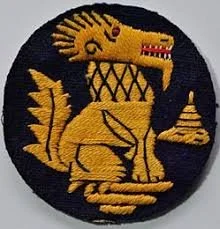
The sign of the Chindits
Long Range Penetration Groups ‘Chindits”
The officially names Long Rage Penetration Groups, otherwise known as Chindits were units of the British and Indian armies used during 1943-1944 in the Burma campaign against the Japanese Imperial army. They focused on attacking lines of communication deep behind Japanese lines and their name is a corrupted form of Chinthe, the Burmese word for Lion. Their operations were characterised by long marches through difficult jungle terrain by troops not able to carry enough food and often struck down my malaria and dysentery. There is debate among historians over the extremely high casualty rate and the military value of their operations.
The founder of the Chindits, Orde Wingate had begun to explore guerrilla warfare tactics while under the command of Archibald Wingate in the Middle East Command. He had commanded the unit known at the Gideon Force which was composed of troops from Sudan and Ethiopia as well as partisans. The Gideon Force disrupted the supply lines of Italian forces and collected intelligence.
After the Gideon Force was disbanded in 1942 Wavell, who was now Commander-in Chief India, specifically requested Wingate’s services in Burma, arriving in March 1942. As the Japense conquered Burma, Wingate toured the country and developed his theories of long range penetration and later presented his proposals to Wavell in Dehli.
In India, Wingate was given permission to form the first Chndit unit, the 77th Indian Infantry Brigade. Half of the Chindit’s were British, the other portion were Gurkha’s from Nepal. This unit was trained by Wingate in the jungles of central India during the rainy season. He trained the force as long range penetration units that were to be supplied by stores parachuted from transport air craft, and were to use close air support instead of heavy artillery for support. Rather than brigades and battalions like conventional forces are structures, the force was instead formed into eight columns. Each man would have to carry around 33kg (72 pounds) of kit which was more than the mules carried. This weight would include a personal weapon, ammunition for a Sten Gun, grenades, a machete (or Kukri for Gurkhas) seven days rations, a groundsheet and spare uniform.
Originally the Chindits were to be used as part of a larger offensive in Burma. When the offensive was cancelled, Wingate convinced Wavell to send them into Burma anyway. What became known as Operation Longcloth began, and the Chindits with Wingate marched in Burma, 3000 strong. They commenced on 8th February 1943 and crossed the Chindwin river on 13th February. They would get their first contact with Japanese troops on 15th February. Over the course of the war, the Chindits would conduct many such operations deep behind enemy lines, often being forced to leave wounded men behind.
The Chindits would suffer many casualties. 1396 Chindits would be killed with 2434 injured. Over half would be confined to hospital needing a special nutritional diet to combat malnutrition. Once recovered, the men were sent to training camps to await new operations. However when army command evaluated the men and equipment needed to return them to operational status, it was decided to transform them to an airborne division instead. The Chindits were finally disbanded in February 1945. Wingate would not live to see this, dying in an aircraft crash in March 1944.
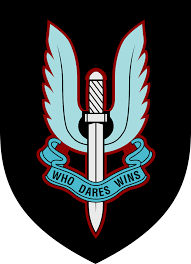
The SAS Cap Badge
Special Air Service
Founded by David Stirling in 1941, the Special Air Service is perhaps the most famous special forces in the world. Originally called ‘L’ Detachment Special Air Service Brigade it would become known simply as the Special Air Service or SAS. The naming was a disinformation campaign to make the Axis think think there was a paratroop regiment with several units operating in the area.
It was conceived that as a commando force to operate behind enemy lines in the North African Campagin and initially consisted of only five officers and sixty other ranks. It first operation, Operation Squatter was conducted in November 1941 in support of Operation Crusader offensive. Due to a mix of adverse weather and german resistance, only twenty two men would make it back to base, the rest either killed or captured. Its second mission however was a major success. Transported by the Long Range Desert Group rather than aircraft, it attacked three airfields in Libya and destroyed sixty aircraft, without a single man lost. In September 1942 it was renamed 1 SAS, cosnisting of four British Squadrons, one Free French, one Greek and the Folboat Section of the SBS.
In January 1943 Colonel David Stirling was captured in Tunisia and the famous Paddy Mayne replaced him as Commander. In April 1943 the 1st SAS was reorganised into the Special Raiding Squadron under Mayne’s command and the SBS was placed under command of George Jellicoe. The SRS fought in Sicily and Italy along with the 2nd SAS which had been formed in 1943 under the command of Bill Stirling (brother of David Stirling). In 1944 the SAS Brigade was formed. 1st and 2nd SAS were British units. 3rd and 4th SAS were French units, 5th SAS was Belgian and F Squadron was responsible for signals and communication.
The SAS Brigade was tasked with parachute operations behind the German lines in France and carried out multiple operations supporting the allied advance through France, Belgium, Holland and later Germany. Due to the Commando Order of 1942 the unit faced the risk of being executed by German forces if captured. Indeed, in July 1944 following Operation Bulbasket 34 men of the SAS were summarily executed by the Germans, and in October 1944, a further 31 were executed following Operation Loyton.
After being disbanded at the end of the Second World War, the SAS would later be reformed. It now consists of one regular unit (22 SAS) and two reserve units (21 & 23 SAS). It now take the lead in most counter terror operations of the United Kingdom and is largely considered to the best Special Forces in the world.